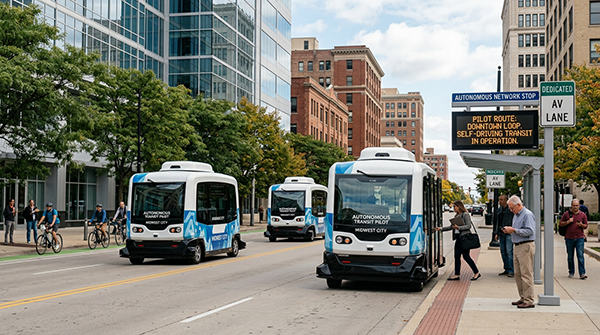
Officials claim the system could redefine urban mobility if early results hold.
A mid-sized Midwestern city has quietly launched one of the most ambitious autonomous public transit networks in the United States: a fully autonomous public transit network operating without drivers. The system combines electric buses, dynamic routing algorithms, and real-time passenger demand tracking.
The network currently operates across 12 routes covering the city’s downtown core and three major suburban corridors. Buses equipped with lidar, cameras, and redundant navigation systems operate at speeds up to 35 miles per hour, navigating mixed traffic conditions alongside conventional vehicles, cyclists, and pedestrians.
Early ridership data suggests strong public acceptance, with passenger counts exceeding projections by roughly 40 percent in the first month of operation. City officials attribute the higher-than-expected adoption to the system’s reliability, with on-time performance averaging 94 percent compared to 78 percent for the previous human-operated bus network.
Transit unions have expressed concern about the displacement of professional drivers, while transportation policy experts debate whether the model can be replicated in larger, more complex urban environments. The city has committed to retraining programs for affected workers and has emphasized that the pilot program creates new technical positions in fleet management and system monitoring.
Federal transportation officials are closely watching the experiment, which could influence national policy on autonomous vehicle deployment in public transit applications.